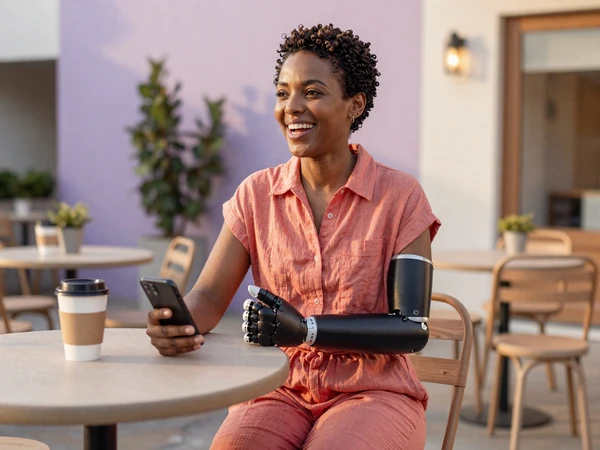
Dating After Limb Loss: A Confidence Guide for Amputees
A warm, no-pity 2026 playbook for re-entering the dating world after amputation - the emotional reset that matters most, the bio styles that actually get replies, and the disclosure script you can copy tonight.
By the InclusiveDating editorial team••9 min read
Quick Takeaways
Confidence is built, not waited for. Small social wins recalibrate the brain faster than any pep talk.
Body image research is sobering but hopeful. PLOS ONE found image scores drop after amputation, but self-worth itself does not.
Three bio styles work in 2026: humorous, casual, and deep-connection - pick the one that sounds like you out loud.
The Universal Disclosure Script reframes limb loss as transparent information, not a confession.
Rejection is rare and useful. The wrong reactions are early data, not personal failures.
The Emotional Reset: Why Confidence Comes Before Swiping
Most amputee dating advice skips the part that matters most - the inner reset that has to happen before any app makes sense. Confidence is not the starting point of dating after limb loss; it is the byproduct of dating after limb loss. You do not arrive ready and then start swiping. You start swiping, very gently, and arrive ready somewhere around the third or fourth conversation that did not end the way you feared.
This matters because the brain after amputation is running a quiet prediction model: they will reject me, so do not invest. Every small social win - a reply, a flirt, a coffee that turned into two - overwrites that prediction. Waiting until you "feel 100%" is the trap. Nobody feels 100% before doing something this vulnerable, and people without limb loss certainly do not.
"Confidence is not the price of admission for dating after amputation. It is the receipt you collect on the way out."
- A common reframing on AbleSingles and in amputee peer-support groups
The other quiet shift to make is staying physically engaged with your body - not for a future partner's benefit, but for the conversation between you and yourself. Movement reminds the body what it can still do, which is a different message than the mirror has been giving it.
The Research
What Studies Say About Body Image and Amputee Dating
Two studies worth quoting at your next therapy session - both show the problem is solvable, not permanent.
149
amputees studied showed significantly lower body image scores than controls (p<0.001) - but self-worth itself was unchanged.
PLOS ONE, lower-limb amputation cohort
↑
Physical activity correlates positively with body image after lower-limb amputation. Movement, not mirrors, moves the needle.
Scientific Reports, 2023
3 days
is how long it took Kaci - a disabled dater featured in People Magazine - to meet her future husband on an accessible dating platform.
People Magazine feature on disability dating
The headline finding is the important one: your body image takes a hit after amputation, but your self-worth - the deeper sense that you are a person worth loving - does not move much in the data. That gap is where the work happens. You are not rebuilding your value as a partner. You are reconciling how you see your body with the value that was never actually lost.
Profile Strategy
Three Bio Styles That Work in 2026
There is no single 'right' way to mention amputation in a profile. Pick the voice that matches how you sound when you are relaxed with friends.
①
Humorous-Direct
Best for Tinder, Bumble, and casual swipe apps. Lead with a wink: "Bionic leg, full-strength sense of humour, will out-walk you at the museum." Disarms tension immediately and pre-filters for people who can match your energy.
②
Casual-Mention
Best for Hinge and prompt-driven apps. Drop the prosthesis in like any other detail: "Coffee snob, terrible at karaoke, occasional pit stop to adjust my prosthetic." Treats limb loss as part of the texture of your life, not the headline.
③
Deep-Connection
Best for serious dating and platforms like our amputee dating site. Frame limb loss as one chapter, not the whole book: "Lost my leg three years ago. It shaped me, it does not define me, and I am here looking for something real."
Photos: show the prosthesis, don't hide it
Profiles where the prosthesis is visible in at least one photo consistently outperform "reveal later" profiles in reply quality. Photo verification badges plus a clear, well-lit shot in everyday clothes filter out the wrong people up front and reward the right ones with relief - they already know, and they swiped right anyway. The same logic applies on any amputee dating site with verification built in.
The Universal Disclosure Script (Copy-Paste Ready)
If you prefer to mention amputation before meeting in person - rather than in the profile itself - there is a tested wording that lands well. It is informative, not confessional. It opens a door instead of asking for permission.
Send before the first date:
"Hey, just wanted to mention before we meet - I lost my leg a few years ago and use a prosthesis. It doesn't change my daily life much, but I like to be transparent early on. If you have any questions at all, feel free to ask!"
Notice what the script does not do. It does not apologise. It does not invite reassurance. It does not turn the message into a vulnerability dump. It treats the information the way you would treat any other true fact - I have a cat, I'm vegetarian, I have a prosthesis - and lets the other person respond like an adult. Most do. The ones who don't were going to be a problem at minute fifteen of the date anyway.
Adjust the timeframe (a few years, eighteen months, since birth) and the limb. Keep the tone. The line "If you have any questions at all, feel free to ask" is the secret ingredient - it gives the other person permission to be curious without feeling like they are intruding.
Prosthetics, Intimacy, and Real Closeness
Physical intimacy after amputation is the topic most dating guides skip, which is unfortunate, because it is also one of the easiest to handle once you stop treating it as a separate species of conversation. There is no universal rule. Some amputees prefer to remove the prosthesis during intimacy; others keep it on. Both are valid. The only person whose comfort sets the policy is the person with the amputation.
The conversation does not need to be formal. A working line, borrowed from the AbleSingles 2026 Confidence Blueprint, is: "Let me know if you have questions; I'm happy to talk about what works for me." That single sentence does three things at once. It signals openness, takes the burden of guessing off your partner, and quietly establishes that you are the expert on your own body.
What partners usually want to know (and rarely ask)
Whether to mention the prosthesis or pretend not to notice it - please mention it, the pretending is exhausting for both of you.
Whether they can touch the limb or the residuum - yes, when invited, just like any other part.
Whether sex will look very different - sometimes positions shift, the chemistry does not.
Whether you will be self-conscious - sometimes; intimacy is a series of small accommodations, not a single big reveal.
How Partners Actually React (and Who to Filter Out)
The most common mistake amputees make in dating is pre-rejecting partners on the assumed-rejector's behalf. You read someone's profile, decide they "would never go for someone with a prosthesis," and swipe left before they had any say. This feels protective. It is actually presumption - you are thinking on behalf of another adult, and you are usually wrong.
Let people respond. Their reaction is real information, and information is always better than a story you wrote in your head.
Their reaction
What it actually means
"Thanks for letting me know - looking forward to Saturday."
The right kind of partner. Treats the info as info. Keep going.
Genuine, curious follow-up questions.
Healthy attention. Curiosity is not fetishization when it stops at "I'd like to understand you better."
"Wow, you're so brave / so inspiring just for dating."
Yellow flag. The inspiration-porn frame rarely turns into respect. Push back gently; if it persists, move on.
Sudden ghosting after disclosure.
Saved you time. Someone who exits over information is not equipped for actual partnership.
Hyper-focus on the limb, intense questions about the stump, requests for photos.
Amputation works as an early compatibility filter - possibly the most efficient filter in dating. People who self-eliminate over limb loss were not going to be steady, accepting, long-term partners regardless. Their exit is not your loss. It is the algorithm doing its job for free.
Real Story
Success Story: Finding Love Again After Limb Loss
“
I lost my leg in a car accident at twenty-nine and assumed dating was over. Three years later, I built a profile that said 'one chapter, not the whole book' and let the prosthesis show in the second photo. I matched with my now-fiancé within the first week. When we finally met he just said, 'thanks for being upfront - saved us both a weird dinner.' I cried in my car after. In a good way.
Frequently Asked
Amputee Dating: Frequently Asked Questions
How do amputees start dating again?
Amputees start dating again by treating confidence as something built through small social wins, not something to wait for. Begin with low-stakes interactions - texting, video calls, coffee - on platforms with verification and accessibility features rather than swipe-heavy mainstream apps. Mention the amputation either in your profile or via the Universal Disclosure Script before the first meeting, choose date locations with simple logistics, and let other people respond rather than pre-rejecting them on their behalf. Most amputees report that the first three positive interactions are the ones that flip the internal narrative permanently.
Should I mention my amputation in my dating profile?
Both approaches work, and the choice should be a decision, not a fear. Mentioning it in your profile (with at least one photo showing the prosthesis) filters compatible matches faster and removes the disclosure conversation entirely. Not mentioning it gives you more reply volume but moves the conversation to the messaging stage. There is no wrong answer - what matters is that you chose, rather than hiding by default. On a dedicated amputee dating site this is built in; on mainstream apps you are doing the filtering manually.
When is the best time to disclose limb loss to a date?
The best time to disclose limb loss is before the first in-person meeting, typically once a real meet-up is being scheduled. This gives the other person time to ask questions in writing and removes any element of surprise at the venue. The Universal Disclosure Script - a short, neutral message stating the fact, normalizing it, and inviting questions - works in nearly every situation. Disclosing at the date itself works too but adds avoidable pressure. Disclosing months in is too late and reads as concealment.
What if my date reacts badly to my amputation?
A bad reaction is useful early data, not a personal failure. People who exit over an amputation were not equipped to be steady, accepting partners regardless - they would have surfaced incompatibility later in a more painful form. The job is to feel the rejection, process it briefly, and resist generalising it to "everyone." Most amputees who keep dating report that bad reactions are rarer than they feared, and the good reactions arrive faster than they expected.
How do I handle intimacy and prosthetics with a new partner?
Handle intimacy by opening a low-pressure conversation early - something like "let me know if you have questions; I am happy to talk about what works for me." Decide in advance whether you prefer the prosthesis on or off during intimacy; both are valid. Invite your partner to ask, touch when invited, and adjust together. The goal is not a perfect first time - it is a series of small accommodations, like any couple makes, with you as the expert on your own body.
Is there a specific dating site for amputees?
Yes - InclusiveDating and similar platforms offer dedicated amputee dating with verification badges, anti-fetishization moderation against devoteeism, accessibility filters for first-date logistics, and a community where limb loss is treated as one detail among many rather than the headline. Specialized platforms typically deliver higher reply quality and faster compatibility filtering than mainstream apps, where amputees report a significantly lower match rate.
Keep Reading
Continue the Confidence Blueprint
♥ Category
Amputee Dating Site
The category hub for amputee dating on InclusiveDating - verified profiles, anti-fetishization policy, first-date logistics, and a Just-in-Case Kit you can build in ten minutes.
The 88% statistic, how to spot devotees and fetishizers, photo verification, safe disclosure practices, and a first-meeting safety plan you can run on any platform.
Verified profiles, anti-fetishization moderation, and a community that treats limb loss as one detail - not the headline. Build the kind of profile this guide describes and meet someone who already gets it.
Free forever · No credit card · Photo verification included