Neurodivergent Couples: Thriving Together When Both Partners Are ND
A 2026 field guide for AuDHD, autistic-autistic, and ADHD-ADHD partnerships - what a shared neurotype actually gives you, how to negotiate sensory differences without resentment, and the household systems that finally make two ND brains feel at home together.
By the InclusiveDating editorial team••9 min read
Quick Verdict: Shared Neurotype Is a Superpower
ND-ND couples skip the translation layer. No more explaining stims, info-dumps, or the need to script a phone call.
AuDHD pairings are common - roughly 50-70% of autistic adults also meet ADHD criteria, per recent clinical reviews.
Sensory negotiation beats sensory compromise. Design rooms, not rules.
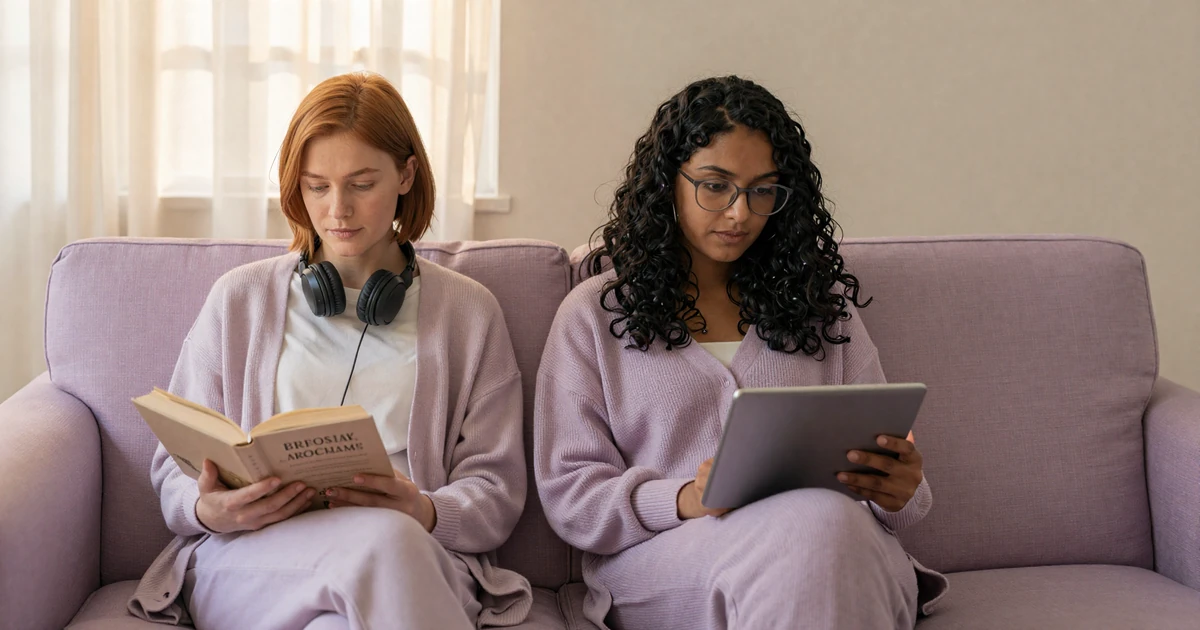
Parallel play is intimacy. Two people in the same room on different screens is closeness, not distance.
The risk is administrative drift - neither brain wants the boring stuff. Outsource what you can, body-double what you cannot.
AuDHD Couples: When Autism and ADHD Overlap
AuDHD - the lived experience of being both autistic and ADHD - is no longer a fringe diagnosis. Recent clinical reviews place overlap somewhere between 50% and 70% of autistic adults, and the community-coined term has become the most-searched neurodivergent identity label of 2026. For couples, this matters because two AuDHD partners are not simply "double ND." They are a specific blend: autistic need for predictability colliding with ADHD's hunger for novelty, sometimes inside the same person, twice over.
The first thing AuDHD couples usually report is relief. The constant internal debate - do I want routine or chaos today? - is finally externalised. One partner names that they need three days of nothing after a stimulating week, and the other partner does not flinch, because they have been there. The autism dating app and ADHD dating categories explore each profile in depth; this guide is about what happens when they share a kitchen.
How AuDHD often shows up day to day
Hyperfocus arrives, runs the household for a week, and then disappears for a month. Routines are created, perfected, abandoned, and rebuilt. Sensory thresholds shift by the hour. Demand avoidance and excitement can land in the same minute. None of this is dysfunction - it is just the system. Once both partners stop expecting linear weeks, the friction drops dramatically.
The Upside
The Benefits of a Shared Neurotype
What ND-ND couples consistently say a mixed-neurotype relationship never gave them - five quiet, daily superpowers of dating someone whose brain runs on the same operating system.
✦
No Translation Layer
You do not have to explain why a fluorescent restaurant is unbearable, why you info-dump when excited, or why you need 20 minutes after a phone call. They already know.
☷
Parallel Play Is Intimacy
Both partners sitting in the same room, headphones on, doing entirely different things - and feeling closer than a "real" date night. Allistic guests will not get it. You will not need them to.
◐
Masking Drops at Home
The exhausting performance of neurotypical body language, eye contact, and tone modulation can finally switch off. Studies link long-term masking to autistic burnout - home becomes recovery, not another stage.
⊙
Special Interests Are Welcomed
Three-hour deep dives into octopuses, Formula 1, or 1970s synthesisers are not "too much." They are foreplay for the brain - and often the spark of the relationship.
☼
Shared Sensory Vocabulary
Words like overstimulated, understimulated, low-spoons, glimmer, and meltdown vs shutdown are first-language. Negotiation happens in seconds, not arguments.
✶
Direct Communication, Honoured
Saying exactly what you mean is not 'blunt' or 'cold' - it is the relationship's primary love language. No subtext to decode, no hidden tests to fail.
Navigating Sensory Differences Without Conflict
The myth that two ND partners automatically have matching sensory profiles falls apart within a week of living together. One partner runs hot and needs silence; the other runs cold and needs a background podcast. One is touch-seeking; the other is touch-avoidant after 6pm. Same neurotype, opposite wiring.
The principle ND-ND couples use is design rooms, not rules. Rather than negotiate every moment, you build the environment so both nervous systems can rest in it.
Sensory clash
ND-ND solution that works
One partner wants quiet, the other wants ambient noise
Bone-conduction headphones or earbuds with passthrough - same room, different soundscapes
Different lighting tolerances
Layered lighting: dimmable lamps per zone, no overhead fluorescents, warm 2700K bulbs everywhere
Touch-seeking vs touch-avoidant in the same evening
A traffic-light hand signal: green = welcome, yellow = ask first, red = not now. Updates without explanation
Temperature wars
Heated blanket on one side of the bed, fan on the other - stop trying to share one climate
Smell sensitivities (cooking, products)
Fragrance-free household products, ventilation when cooking, no scented candles in shared rooms
Texture mismatch in food, fabric, bedding
Two duvets on one bed, parallel "safe foods" stocked weekly, no negotiation needed at dinner
Communication Scripts ND Couples Actually Use
Scripts are not childish. They are an accessibility tool. A pre-agreed sentence cuts through the moment your working memory, mood regulation, or speech processing is offline - which, for two ND partners, will be several times a week. Print these on a fridge magnet.
"I'm at capacity - I'm not upset with you. I need 40 minutes of nothing and then I'll come back."
- The most-used ND-ND sentence on our community forum
Six scripts to steal
Bandwidth check: "Is now a 1-to-5 word answer moment, or a real conversation moment?"
Sensory exit: "I love you and I'm leaving the room - it's the lights, not you."
Info-dump consent: "Can I tell you something I'm hyperfixated on right now for ten minutes?"
Repair after shutdown: "I went offline earlier. I'm back. Do you want to talk about it or skip it?"
Plan check: "Are we doing the thing at 7, or doing-the-thing-doing the thing at 7?" (Allistic readers, do not worry about it.)
The meltdown signal: A single word - "weather" - meaning I am dysregulated, no questions, low light, no touch, no fixing. Agree on it once, never explain it again.
The ADHD relationships guide covers conflict-specific scripts; this one focuses on the quiet, daily regulation language two ND brains need.
Household Systems That Work for ND Brains
The single biggest risk in an ND-ND household is not conflict - it is administrative drift. Bills float, appointments evaporate, the fridge becomes a science project. Neither partner is "the responsible one." That is fine, as long as the household itself becomes responsible for you.
Automate every recurring decision. Autopay, repeating grocery deliveries, subscription meal kits when budget allows, a robot vacuum on a daily schedule. Every recurring choice you remove is one less executive function tax.
Visible, not memorised. A whiteboard, a shared Notion, or a fridge calendar - anything inside the house, in eyeshot, that does not live in an app you forget to open.
End-to-end ownership, not "helping." Whoever owns the laundry owns noticing, doing, and folding. The other partner does not ask. This stops the parent-child dynamic before it starts.
Body-doubling for the boring stuff. Friday admin hour, side by side, snacks and music. Taxes, replies to emails, calls to landlords - anything that resists solo motivation.
Spoon forecasts on Sunday. A five-minute weekly check: how are we both doing energy-wise, what is non-negotiable this week, what gets dropped if Wednesday goes sideways?
Intimacy and the Neurodivergent Brain
Intimacy on a neurodivergent brain looks different, and ND-ND couples are usually relieved to discover their version is the version. Spontaneous, allistic-coded sex - "the mood just struck" - is rarely the norm. Scheduled intimacy, sensory-curated environments, and explicit verbal consent in the moment are.
What ND-ND intimacy often actually looks like
Scheduling without shame. A calendar entry for closeness is not unromantic - it is the brain finally being able to look forward to something.
Explicit sensory negotiation: light off or dim, weighted blanket on or off, music or silence, soft fabrics, no scented anything. Asked once, set up forever.
Touch menus, not mind-reading. "Tonight I'm a 7 for cuddles, a 3 for anything else." Both partners orient instantly.
Aftercare for the nervous system. Quiet wind-down, water, a familiar show - built into the routine, not an afterthought.
Demand-avoidance respect. PDA-style profiles need invitations, not expectations. "Would you like to?" beats "We should."
In Their Own Words
Real ND Couples Sharing What Works
“
We're both AuDHD. The first month I kept waiting for her to be annoyed that I needed two hours of silence after a work call. She just handed me my headphones and went back to her book. That was the moment I knew.
“
Two autistic adults on the same special interest is genuinely a love language. We've been talking about trains for three years. Other couples have date nights. We have a spreadsheet.
“
We're both ADHD and we accepted early on that neither of us would be the responsible adult. We hired a bookkeeper instead. Best $80 a month we spend on the relationship.
Continue Reading
Continue Reading
♥ Category
Autism Dating App
Why mainstream apps fail autistic adults, and how low-sensory UI, structured prompts, and friendship-first matching change the experience.
ND-ND relationships are not universally "better," but they often feel easier in daily life because both partners share the same operating system. There is no translation layer for stimming, info-dumping, sensory needs, or scripted communication, and masking can drop at home - which long-term studies link to lower burnout. The trade-off is administrative drift: neither brain naturally gravitates to bills and chores. Couples who automate recurring decisions, body-double the boring tasks, and respect end-to-end ownership tend to thrive long-term.
How do AuDHD couples communicate?
AuDHD couples communicate best with explicit, low-ambiguity language and pre-agreed scripts. Common patterns include a bandwidth check before serious conversations ("1-to-5 word answer or real conversation?"), a single safe word like "weather" to signal dysregulation without explanation, written agreements for important decisions because verbal memory is unreliable, and consent-based info-dumping ("can I tell you about this hyperfixation for ten minutes?"). Direct speech is honoured as a love language, not read as bluntness.
Where do neurodivergent people meet?
Neurodivergent people meet on neurodivergent-aware dating platforms (like InclusiveDating), special-interest communities (Discord servers, fandoms, hobby meetups), AuDHD and autistic adult support groups, neuro-affirming therapy or coaching groups, and increasingly through TikTok and creator communities focused on ND identity. Mainstream swipe apps remain difficult because they reward fast response times, ambiguous flirting, and high-stimulation venues - all of which disadvantage ND profiles. Purpose-built platforms with structured prompts and friendship-first options change the odds dramatically.
Is AuDHD a real diagnosis?
AuDHD is a community-coined term rather than a single DSM diagnosis, but recent clinical reviews recognise that 50-70% of autistic adults also meet criteria for ADHD, and many ADHD adults are autistic. Most diagnosticians now assess both during the same evaluation. The lived experience - predictability needs colliding with novelty needs, sometimes inside the same hour - is widely documented and increasingly central to neurodivergent couples therapy and writing.
How do ND couples handle sensory differences?
ND couples handle sensory differences by designing the environment rather than negotiating each moment. Practical patterns include two duvets on one bed for temperature differences, bone-conduction headphones for parallel soundscapes in the same room, layered warm lighting instead of overhead fluorescents, fragrance-free household products, and pre-agreed signals (a hand sign or single word) to update sensory state without long explanations. The principle is "design rooms, not rules."
Can two ADHD partners have a stable relationship?
Yes - two ADHD partners can have very stable relationships, but stability comes from the household structure rather than individual willpower. Successful ADHD-ADHD couples automate every recurring decision they can afford to (autopay, grocery delivery, robot vacuums), use a weekly body-doubled admin hour, build visible shared systems instead of relying on memory, and often hire external support (bookkeeper, ADHD coach) for the executive function gap. The diagnosis is not the predictor of stability - the systems around it are.
Meet Neurodivergent Singles Today
Skip the apps that punish stims, slow replies, and special interests. Join InclusiveDating to meet autistic, ADHD, and AuDHD singles on a platform built around how your brain actually works.
Free forever · No credit card · Friendship-first option · Neurodivergent-affirming community