
Deaf Dating Site
ASL singles, HoH daters, late-deafened adults, CI users and hearing ASL learners - meet on a platform built for every Deaf communication style.
Explore Deaf datingAn honest 2026 guide for Deaf, hard of hearing, and hearing partners on choosing communication modes, respecting Deaf culture, learning useful ASL, picking the right venues, and using the captioning tools that actually work in real life.
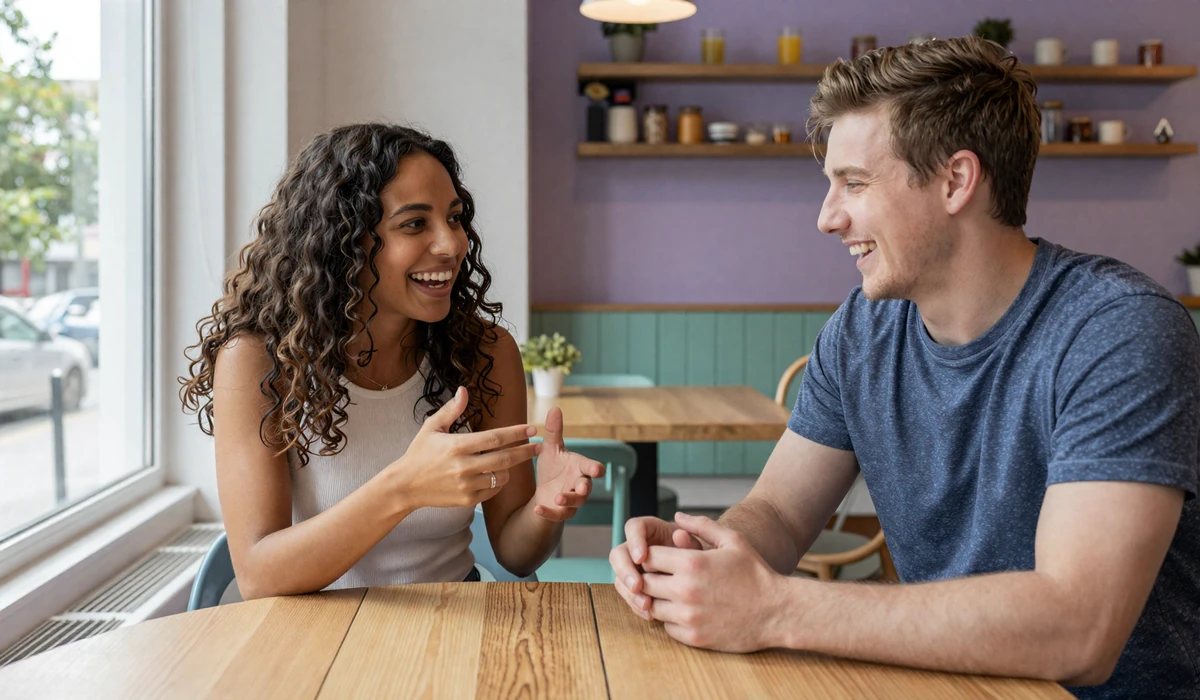
Deaf, hard of hearing, late-deafened, and cochlear implant users all communicate differently. The first real conversation in any Deaf dating relationship is about mode - and most couples use two or three modes depending on the situation.
For culturally Deaf singles, ASL is usually the primary mode. It carries tone, humour, and identity in ways text never will. Hearing partners commit to learning - not perfectly, but consistently.
Many hard of hearing daters lip-read alongside residual hearing. It only works with face-on lighting, clear articulation, no covered mouths, and venues quieter than the average bar.
Texting, in-app chat, and shared notes apps level the field completely. Many couples text across the table on first dates - it removes the pressure of getting voice or signing right under nerves.
For long-distance and late-deafened daters, captioned video calls (Google Meet, Zoom live captions, FaceTime SignTime) carry expression while keeping every word visible.
The most useful question on a first profile read is not "Are you Deaf?" - it is "What is your preferred way to chat?" A single sentence in a profile bio ("ASL preferred, comfortable with text, lip-reading in good light") prevents the first three awkward messages of any conversation. Our deaf dating site category lets daters set those preferences as filters, which is why ASL-fluent singles, hearing ASL learners, and HoH daters all find each other faster than on mainstream apps.
Most successful Deaf-hearing couples do not pick one mode and stick to it. ASL at home, text in loud restaurants, captioned video when one partner is travelling, lip-reading in well-lit cafes. Flexibility is not compromise - it is the actual skill.
Capital-D Deaf refers to people who identify as part of a linguistic and cultural community with its own language (ASL in the US), humour, art, theatre, and history. Lowercase-d deaf is a medical description. The distinction matters more than most hearing daters realise on date one - and getting it right signals respect faster than any other single thing.
A few patterns worth internalising before the first ASL date:
"We are not broken hearing people. We are whole Deaf people. Date us like that and you will be fine." - A common reframing in the ASL dating community
You do not need to arrive fluent. You do need a real plan to keep learning - because dating a Deaf person while refusing to learn their language is the single biggest red flag the community talks about. The good news: ASL is rich, expressive, and well-resourced online in 2026.
| Resource | Best For | What You'll Get in 30 Days |
|---|---|---|
| Lingvano | Bite-sized daily app practice | Greetings, intro phrases, ~200 signs |
| The ASL App | Reference dictionary with native signers | Lookup any sign you need mid-date |
| Start ASL / Social ASL | Free structured course + video practice | Real grammar, not just vocabulary |
| Gallaudet University YouTube | Authentic Deaf instructors | Cultural context, not just hand shapes |
| Local Deaf coffee chats | Real practice, real community | Friends, accountability, and faster fluency |
Aim for thirty minutes a day for the first month - fingerspelling, common phrases, and at least one conversation topic that matters to your partner (their job, their dog, their favourite show). Skip the Hollywood-style "I-love-you" sign as your only party trick. Most importantly, fingerspell when you do not know a word; pretending to know never lands.
Venue selection is half the success of any Deaf or HoH date. A bad venue forces both partners into a battle with the room; a good one makes communication invisible. The three variables that matter, in order: lighting, background noise, and sightlines.
One small upgrade matters more than people expect: sit at right angles rather than face-to-face across a wide table. Right-angle seating gives clean sightlines for signing and leaves hands free, while still feeling intimate. For more on first-date logistics, see our first date ideas guide - the lighting and noise principles cross over.
In 2026 the tech gap is smaller than it has ever been. Real-time speech-to-text apps run on phones the size of a credit card, and Video Relay Service (VRS) is free under the FCC. Couples who use these tools casually - not as an emergency measure - find communication flows almost without friction.
One ground rule worth setting early: caption-friendly speech is a skill. Hearing partners speak slightly slower, finish their sentences, and avoid talking over the captioner's lag. It feels weird for the first week and then becomes invisible.
Across the InclusiveDating community, mixed-hearing couples are some of the most stable long-term matches we see. Three patterns repeat in almost every story:
Mia and Jordan, matched through our Deaf community filter in early 2025, put it this way: Mia is culturally Deaf and uses ASL; Jordan was a hearing ASL student. By their third date, they had agreed on text in noisy bars, ASL in cafes, and captioned video on travel days. A year later they describe their communication as "more honest than any hearing relationship either of us had before" - and the data backs it: research from Gallaudet University consistently finds Deaf-hearing couples with shared signing skill report higher relationship satisfaction than hearing-hearing controls in the same age band.
ASL singles, HoH daters, late-deafened adults, CI users and hearing ASL learners - meet on a platform built for every Deaf communication style.
Explore Deaf dating
The exact lines to put in your bio - including communication preferences, identity-first phrasing, and timing for sharing your story.
Read the profile guide
Spotting devotees, photo verification, safe disclosure, and the exact first-meeting plan that lets you relax and actually enjoy the date.
Read the safety guideDating a Deaf person starts with asking - never assuming - their preferred communication mode: ASL, lip-reading, text, or captioned video. Show up willing to learn basic American Sign Language, choose well-lit and quiet venues with clear sightlines, keep eye contact while signing, and avoid shouting, exaggerated mouthing, or talking with your face turned away. Treat Deaf identity as a culture, not a deficit, let your partner lead on community decisions, and normalise everyday tools like Live Transcribe and Ava. Most successful Deaf-hearing couples use two or three communication modes depending on the situation.
You do not need to be fluent in ASL on day one, but you do need a real plan to keep learning if your partner is culturally Deaf and signs as their primary language. Refusing to learn is the single most-cited red flag in the Deaf dating community. Aim for thirty minutes of practice a day for the first month using apps like Lingvano, The ASL App, Start ASL, or Gallaudet YouTube channels, and supplement with local Deaf coffee chats. Consistency matters more than perfection - most Deaf partners value visible effort over rehearsed phrases.
The 2026 daily-driver stack for Deaf-hearing couples includes Live Transcribe on Android and Live Captions on iOS for real-time speech-to-text, Ava for multi-speaker dinners and group settings, Otter.ai for long conversations and meetings, Google Meet or Zoom live captions for video calls, FaceTime SignTime or Glide for signed video messages, and Sorenson VRS or Convo for free interpreter-supported phone calls. Combined, these tools close most day-to-day communication gaps. The key is using them casually, not as an emergency measure.
The best venues prioritise good lighting, low background noise, and clear sightlines. Strong choices include daytime cafes with window seating, bookstores, independent galleries, botanical gardens, walking trails, bowling alleys, mini-golf, and open-caption movie screenings. Avoid dim cocktail bars, live music venues, long restaurant tables, and car conversations where the driver cannot see signing. A small upgrade that matters: sit at right angles rather than directly across a wide table to keep sightlines clean and hands free for signing.
Capital-D Deaf refers to people who identify as part of a cultural and linguistic community with its own language, history, and humour - ASL in the United States. Lowercase-d deaf is a medical description of audiological status. Many members of the community prefer "Deaf," "Hard of Hearing," or "HoH." Avoid "hearing-impaired," which is widely seen as deficit-framing, and never use "deaf-mute" or "deaf and dumb," which are outdated and offensive. When in doubt, ask your date which term they use for themselves and mirror their language.
Deaf singles can meet other ASL daters on specialised platforms that let users filter by communication preference - including ASL, lip-reading, text, and captioned video. InclusiveDating offers a dedicated Deaf community filter, profile labels for "ASL preferred" or "HoH friendly," and captioned video chat built in. Other established options include Deafs.com, Deaf Singles Meet, Deaf Match, and Social ASL, which also welcomes hearing ASL learners. In-person, local Deaf coffee chats, ASL clubs, and Gallaudet alumni events remain some of the strongest organic meeting spaces.